
Pennsylvania has long been one of the country’s energy leaders. But when it comes to building new power generation, especially the low-cost solar, wind, and battery energy storage that could help rein in rising bills, the Keystone State is falling behind. A new analysis from Synapse Energy Economics, prepared for the Siting Solutions Project, shows why.
Drawing on PJM interconnection data, project case studies, and a review of nearly 2,000 local ordinance provisions, the analysis finds that the biggest barrier to new energy development in Pennsylvania is local siting, not the regional grid queue.
A Patchwork of Rules With No State Guardrails
Pennsylvania is one of just 13 states in which municipalities alone decide where wind and solar facilities can be built. The other 37 states have either a state siting process or state guardrails on local decisions. That approach has support across the political spectrum, with states as different as West Virginia, Nebraska, and Illinois giving the state a role in making sure critical energy projects can be built at reasonable cost and on a reasonable timeline.
Without that backstop, energy developers in Pennsylvania face a fragmented and unpredictable process across more than 2,500 municipalities. Based on the Pennsylvania State University solar ordinance database, 115 municipalities have restrictive setbacks, height limits, noise limits, or exclusionary uses. Columbia University’s 2026 review of opposition to renewable energy ranks Pennsylvania third in the nation for state and local restrictions and eighth for projects facing significant opposition. Heatmap News estimates that organized opposition and local restrictions led to the cancellation of about 12 GW of renewable projects in Pennsylvania in the fourth quarter of 2025 alone.
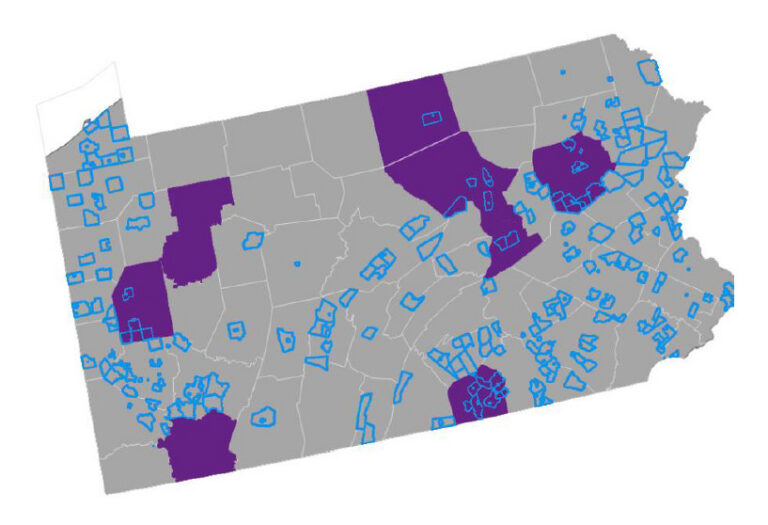
Restrictive solar ordinances in Pennsylvania, with counties shown in purple and municipalities in blue.
The results show up in the state’s energy mix. A 2025 report ranked Pennsylvania 49th in renewable energy growth since 2015, with renewables supplying only about 4% of the state’s electricity.
What the Queue Data Shows
Synapse examined the 145 Pennsylvania energy projects that have entered the PJM interconnection queue since 2023. Of those, 110 have withdrawn. For renewables, the picture is even starker: 75% of Pennsylvania renewable projects that entered the queue since 2023 have withdrawn, representing 82% of renewable capacity in the queue.
Pennsylvania also does worse than the rest of PJM, which is notorious for slow interconnection:
Measure
Pennsylvania
PJM-wide
Projects at active status or beyond
24%
38%
Customer-initiated share of withdrawn renewable capacity
62%
49%
Timing is important, too. Most Pennsylvania projects that withdraw do so at or before the first phase of PJM’s interconnection study. That suggests the underlying problem, such as the lack of a developable site, existed before the project entered the queue. If projects were dropping out late in the process, that would point to engineering or grid problems.
As Synapse concludes, PJM’s queue reforms on their own won’t be enough. Siting reform is needed to unlock renewable development in Pennsylvania.
Real Projects, Real Consequences
Synapse’s solar project case studies show how local siting decisions play out on the ground.
Firefly Solar, a proposed 200 MW project in North Beaver Township, Lawrence County, was cancelled in December 2024 after the township adopted an ordinance restricting solar to industrially zoned land. The ordinance came three years after the developer began signing leases with local farmers and a year after it filed for interconnection. The developer offered $250,000/year for 40 years to the township, the school district, and the county respectively, but it could not get the decision reversed. By the time it withdrew, the project had reached the final stage of the interconnection process.
Wilson Solar, an 80 MW project in Venango Township, won a favorable recommendation from the planning commission. The township supervisors later voted 3-0 to reject it. Many months later, after the developer appealed, the parties settled on a project roughly a quarter of the original size, conditioned on significant community investments by the developer.
Synapse also interviewed a Pennsylvania distributed solar developer who noted that changes forced cancellation of two projects, and site requirements forced redesigns of two more. One township would have required a 500-foot setback while another capped solar coverage at 3% of a lot, compared with a more typical 20-25% of coverage.
The Impact on Pennsylvanian Pocketbooks
The stakes are rising for Pennsylvanians. Utilities in the state project annual electricity demand to grow by 50% over the next five years. On June 1, 2026, generation rates for residential customers of the state’s largest utilities rose by about 6% on average, with some utilities rising 10-12%.
A companion Synapse analysis prepared for Advanced Energy United estimates that reforming restrictive solar ordinances in just the 10 counties that have them – and making 1% of land in those counties available to utility-scale solar development – could unlock 8-12 GW of solar. Synapse’s modeling shows that adding about 10.6 GW of new clean energy across PJM could save the average Pennsylvania household $219/year by 2029.
What Proposed Legislation Would Change
One opportunity for addressing local restrictions is currently waiting in the wings in Harrisburg. The proposed siting bill, HB 2651, would create statewide standards for renewable energy facilities that local ordinances could not exceed.
Synapse estimates it could streamline more than 900 solar ordinance provisions: 90 at the county level and 821 at the local level. It would supersede specific restrictions in 10 counties and 198 municipalities. The bill would also require municipalities to allow energy facilities in agricultural and industrial zones by right, special exception, or conditional use.
Furthermore, the bill includes an appeals pathway to the Pennsylvania Attorney General’s office to resolve disputed ordinances. Under these provisions, the ordinance that blocked Firefly Solar would likely not have been enforceable. The initial Wilson Solar rejection, which relied on aesthetics and farmland preservation, would likely not have been permitted either.
Technology-Neutral in Design, No Different in Impact
One interesting finding of the Synapse analysis is that a tech-neutral siting bill – which covered all generating and energy storage facilities (natural gas, renewables, nuclear, etc.) – would be a massive boom for renewable resources.
Synapse’s analysis shows all 11 Pennsylvania natural gas generation interconnection requests since 2023, totaling about 8 GW, were either upgrades or conversions at existing plants, or lacked enough public information to classify. Those projects use existing sites, so they wouldn’t require new local siting approval.
Even a fully technology-neutral siting law would not have affected any of the gas projects for which Synapse had enough information. Put simply, Pennsylvania’s current siting regime restricts solar, not gas.
The Bottom Line
The state’s fragmented local siting system, not the PJM queue, is holding back energy development. Clear, statewide standards would give local governments a ready-made framework for reasonable project permitting and give developers the predictability they need.
With demand climbing and bills rising, siting reform is one of the most direct tools Pennsylvania has to bring new, lower-cost power online.