

This factsheet distills key insights from “Beyond Preemption: New Legal Strategies for Overcoming Local Opposition to Renewable Energy Projects” by David E. Adelman, Harry Reasoner Regents Chair in Law, The University of Texas at Austin School of Law. Readers are encouraged to consult the full article for complete analysis and citations, or the brief white paper published in collaboration with Siting Solutions Project.
Why Communities Oppose Clean Energy Projects
Clean energy projects bring real economic benefits—hundreds of millions in capital investment and significant property tax revenue with minimal infrastructure demands. Yet local opposition is rising rapidly. Contrary to popular belief, the core problem isn’t NIMBYism—it’s a policy problem: economic benefits are mostly invisible and public engagement is hamstrung by inadequate legal frameworks.
Property tax revenues, the main local benefit offered by clean energy projects, get buried in county budgets making them invisible, while project impacts, both visual and land use, are all too visible. Making matters worse: the Supreme Court “takings doctrine” and further court rulings prevent local governments from conditioning project approvals on tangible community benefits, forcing a binary choice of “take it or leave it” where counties often elect to “leave it,” defaulting to restrictive local zoning, permit denials, or perpetual moratoriums.
Developers, understanding this dynamic, will often react by delaying community engagement until after applying for a permit, out of fear zoning regulations will shift mid-stream, opponents will organize against them, or competitors will beat them to the jump. Communities, in turn, feel cut out of the decision-making process; important siting and land use decisions were made before they even learned of the project, which fuels additional opposition. And the social science is clear on this point: process fairness drives project acceptance more than agreement on outcomes, while bad processes engender opposition.
Fortunately, development agreements—and the negotiations they spark—can help free local governments, developers, and communities from this vicious cycle.
What Are Development Agreements?
Development agreements are a useful tool for delivering tangible community benefits and certainty for developers in a process that’s better for everyone. A development agreement is a contractual framework that significantly reduces project permitting risk in exchange for tangible community benefits. In the agreement, the local government either freezes zoning requirements or creates customized project-specific zoning requirements for a specified period (typically 5-20 years), and in return, the developer provides negotiated benefits to the community.
Crucially, development agreements aren’t conditions on permits; such conditions would violate takings doctrine. Rather, development agreements are voluntary contracts where both parties get something valuable that they couldn’t obtain otherwise. The developer can lock in a less arbitrary set of siting standards and certainty that zoning won’t change mid-project, while the local government receives earlier engagement and more meaningful, visible benefits for their community.
Why Development Agreements Work
Development agreements (DAs) are perfectly suited to clean energy challenges because they:
Give developers early regulatory certainty.
DAs vest development rights when the agreement is signed, rather than at the time that construction permits are issued (the default under state court precedent), eliminating regulatory risks that can upend projects mid-stream.
Enable early engagement.
DAs can be signed at any stage of development, protecting developers while allowing community input before decisions feel predetermined.
Provide a legal framework for real negotiation.
Both parties have leverage and something valuable to trade: developers offer community benefits and local governments offer regulatory certainty.
Avoid constitutional takings and deliver visible, flexible benefits.
Because independent, contractual agreements circumvent constitutional takings precedent, communities can negotiate what matters locally: direct resident payments, dedicated investments (new schools, health facilities), infrastructure (broadband, emergency services), good-neighbor payments, or reduced electricity rates, which would be categorically prohibited as conditions on a permit or requirements in a local ordinance.
Build long-term social license.
Rather than short-term legal wins or conflict, DAs create a sustainable framework for clean energy deployment without overriding local authority.
Why Alternatives Fall Short
Community Benefits Agreements (CBAs)
are the most common tool today. While they can be negotiated anywhere, they have critical limitations: legal uncertainty about enforcement, and limited leverage for local governments since CBAs must be carefully separated from permit decisions to avoid takings issues
Payments in Lieu of Taxes (PILOTs)
are authorized in just six states. They provide tax certainty for developers and flexible revenue for communities, but most state laws restrict payment amounts and revenue uses. PILOTs are valuable but more limited than development agreements.
While CBAs, PILOTs, and DAs all have drawbacks, they can be combined with each other to great effect, amplifying their impact and reducing their deficiencies
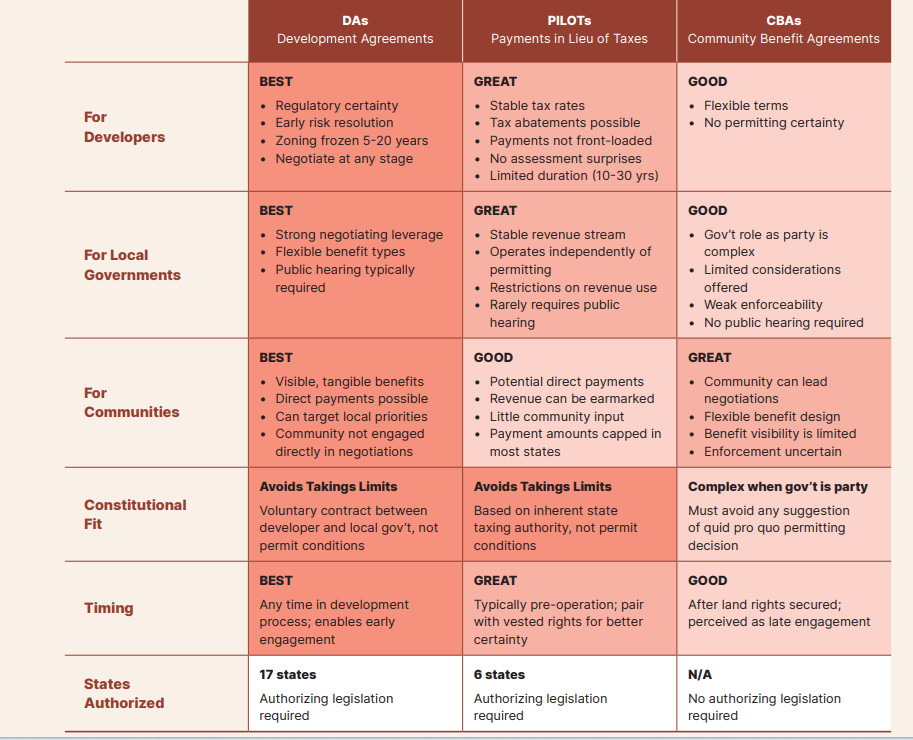
- Regulatory certainty
- Early risk resolution
- Zoning frozen 5–20 years
- Negotiate at any stage
- Stable tax rates
- Tax abatements possible
- Payments not front-loaded
- No assessment surprises
- Limited duration (10–30 yrs)
- Flexible terms
- No permitting certainty
- Strong negotiating leverage
- Flexible benefit types
- Public hearing typically required
- Stable revenue stream
- Operates independently of permitting
- Restrictions on revenue use
- Rarely requires public hearing
- Gov’t role as party is complex
- Limited considerations offered
- Weak enforceability
- No public hearing required
- Visible, tangible benefits
- Direct payments possible
- Can target local priorities
- Community not engaged directly in negotiations
- Potential direct payments
- Revenue can be earmarked
- Little community input
- Payment amounts capped in most states
- Community can lead negotiations
- Flexible benefit design
- Benefit visibility is limited
- Enforcement uncertain
Voluntary contract between developer and local gov’t, not permit conditions
Based on inherent state taxing authority, not permit conditions
Must avoid any suggestion of quid pro quo permitting decision
Any time in development process; enables early engagement
Typically pre-operation; pair with vested rights for better certainty
After land rights secured; perceived as late engagement
Authorizing legislation required
Authorizing legislation required
No authorizing legislation required
What Authorizing Legislation Should Include
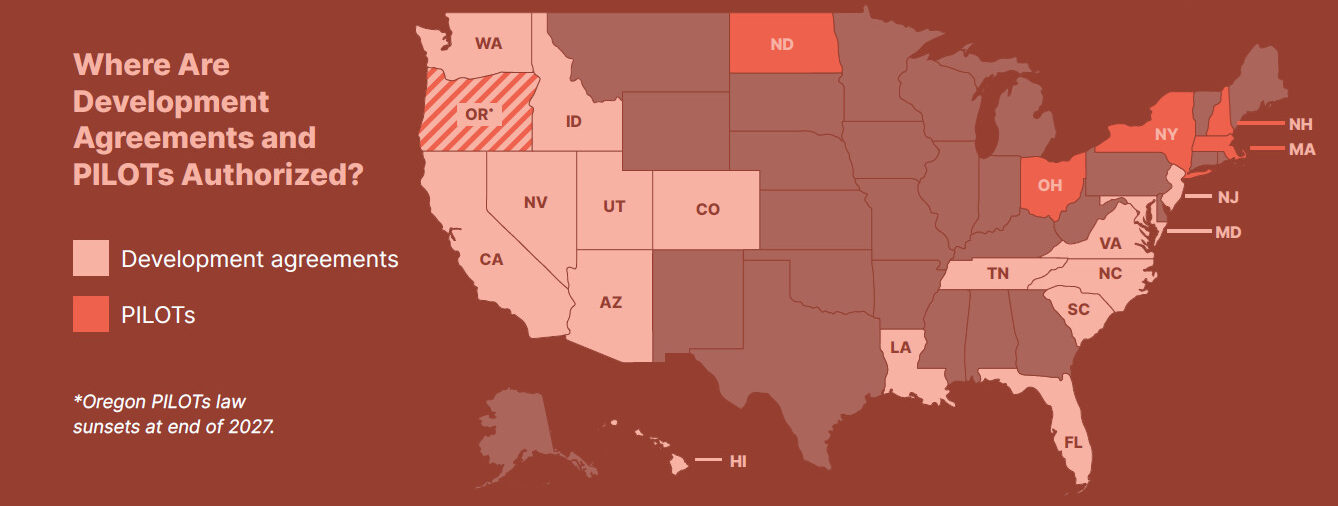
Most of the 17 states with DA laws, including California, Florida, North Carolina, and Virginia, have adopted similar legal frameworks. Key elements include:
- Authority for local governments to enter binding contracts that freeze zoning for specified periods, typically 5 to 20 years.
- Flexibility to negotiate zoning terms beyond existing ordinances but consistent with the local general plan or the public interest.
- Public hearing requirements before final approval, with meaningful notice and timing provisions.
- Reserved authority for state and local government to enact subsequent laws protecting public health and safety, and stipulations that local government agreements are not binding on the state or federal government.
- Community representation requirements during negotiations. This element is especially important feature in counties where the project location is geographically distant from the county seat and rural community interests may not be adequately represented by county-level officials.
Next Steps: What You Can Do
Local Governments
- Where DAs are authorized, plan proactively for their use by identifying local government principles and priorities.
- When approached by a developer, use DAs—plus predetermined principles and priorities—as a tool for constructive negotiation for new clean energy projects.
- Where DAs are not authorized, speak with your legislative representatives about making them available.
State Legislators and Legislative Staff
- Where DAs are not authorized, draft and introduce authorizing legislation based on existing law in 17 states.
- Where DAs are authorized, consider pairing DA authorization with PILOT authorization for maximum flexibility.
Clean Energy Developers
- Request development agreements with local governments in states where authorized.
- Invest in meaningful engagement early on with local governments—agreements protect against competitors and provide certainty, while enabling community input.
The Bottom Line
Clean energy deployment at scale requires local acceptance, not just legal authority, to proceed. Development agreements align developer and community interests rather than overriding them. They give developers the certainty they need and communities the meaningful benefits they deserve. The tool exists, the evidence supports it, and state authorization is needed to make it available.